 PodcastBig Weird Swings with Skyler Gisondo & Austin Abrams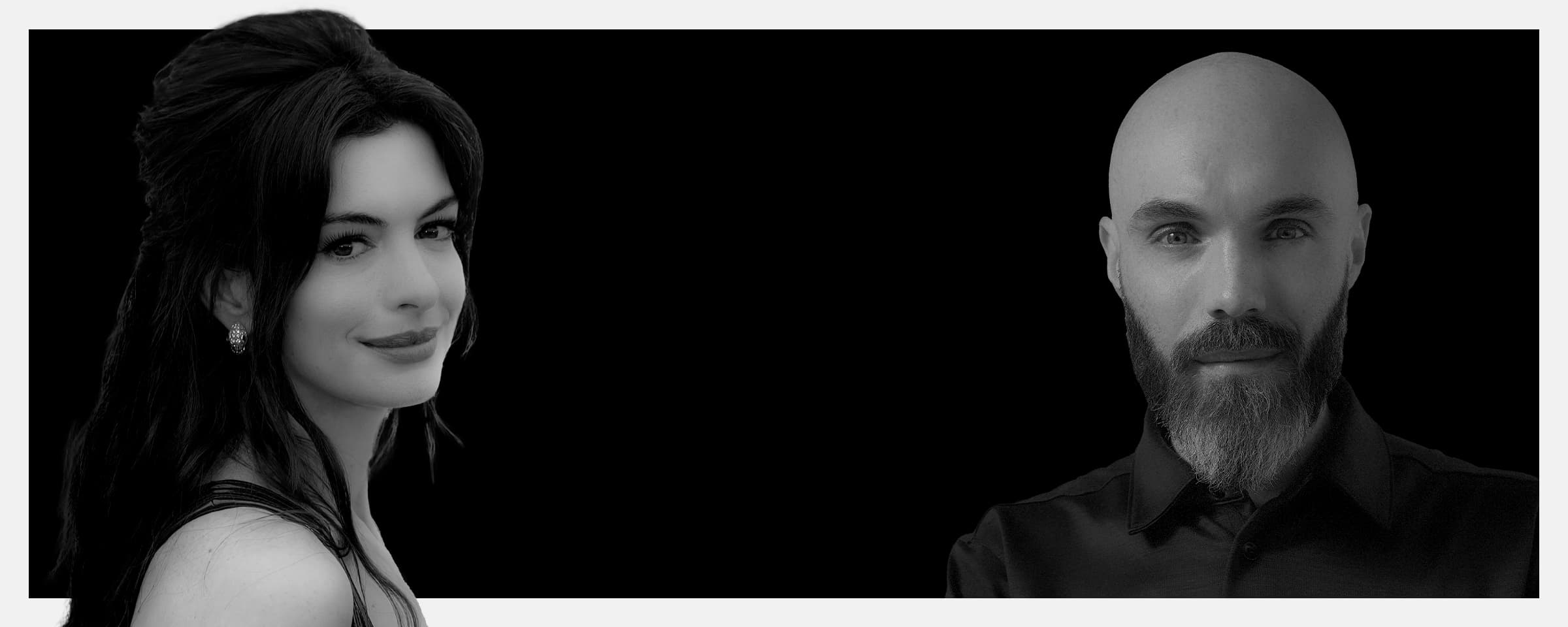
A deep dive into the transformative experience of bringing Mother Mary to life with director David Lowery and Anne Hathaway.
Topics covered include: Deep collaboration, early drafts of Mother Mary, being quick to discard dialogue, finding inspiration in the Faroe Islands, Anne's fear of making the easy choice, the qualities of being a Texas gentleman, the touchstone records that the cast listened to on set from Ke$ha to St. Vincent, Anne’s intensive pre-production process, David offering a special live reading from the Mother Mary script, dance as a monologue, feeling truly transformed as a person after completing the film, bleeding hearts, and praise for Nick Cave.
David Lowery: Hi, I'm David Lowery.
Anne Hathaway: And I'm Anne Hathaway.
David Lowery: And this is the A24 podcast. And I've been doing a lot of podcasts lately, and wondering what it's like to be in the moderator seat, and I realize now that I don't like it.
Anne Hathaway: Does it feel different than being a director?
David Lowery: I feel I can get away with just, you've experienced this on set when I just unleash a slew of words that don't necessarily make sense but hopefully convey the emotion of what I'm trying to ask for. And I feel like I can't get away with that behind the microphone right now.
Anne Hathaway: Well, one of the things that I've experienced when I find that I'm in my favorite deep collaboration with a director is we get to a place where you don't have to say anything. I can feel when I'm acting how they feel about a take, and then they'll come out from behind the monitor and just kind of give me a look, and I raise my hand. Or they'll come over and put their head against my head and I feel like I'm downloaded. And anyway, all this is to say, that doesn't work in a podcast.
David Lowery: It doesn't work in podcasts.
Anne Hathaway: You and I just touch heads for half an hour.
David Lowery: Yeah, exactly. That sounds cool.
Anne Hathaway: And everyone's like, "Well."
David Lowery: Yeah, it sounds like an experience.
Anne Hathaway: But I felt that that was our thing on this one. I felt like you and Michaela connected over the power of the words, you both being writers. And I felt that given, and we've talked about this, given that Mother Mary is an emotionally inarticulate person, I actually found that it really hampered my ability to communicate while I was her. And I felt like Mother Mary's an expression of the part of you that sometimes finds it difficult to find your words. So between the two of us, we had no choice but to trust the wavelength.
David Lowery: Completely. I require those wavelengths to help me through life. I wish I could speak the way Sam does, and in writing that part and then witnessing the way Michaela played it, I was living a fantasy life, in which I could say exactly the right thing at exactly the right moment.
Anne Hathaway: But you can write the things.
David Lowery: I can write it. And if I was able to type this podcast out, it would be far more eloquent.
Anne Hathaway: I would have a lot of fun typing a podcast out with you. It'd be a different format.
David Lowery: Wouldn't that be neat to just sit here and just type and when the text could play out? And again, we'd be channeling an interesting wavelength that would be... You know what is interesting? I have been going back through old drafts of the script. I was looking for the very first one from 2019. I found when I started writing during COVID. And for some reason in this version, it was because I was going to the Pharaoh Islands for a different project, but I was like, "What if Sam's house is in the Pharaoh Islands?" I was very inspired by that landscape. But I don't know if it was because we were all wearing masks, it must have been, but I decided that in this iteration of the screenplay Sam's house had a vow of silence, and no one was allowed to speak. And she had custom index cards, or custom stationary. And the only communication was through the written word. And so it was all the same dialogue, but it had to flow differently because it was all taking the time to write it.
Anne Hathaway: The film also would've been 19 hours long.
David Lowery: Oh, that's why I stopped that version. That version made it all the way up to the dance scene.
Anne Hathaway: I do love that version. In my head, in my head. And I think I would like to see it in a museum.
David Lowery: It 100% was a museum piece.
Anne Hathaway: See, and actually, I have to say that just reminded me of something that I just treasure about you, and it came up earlier in a different conversation I was having with somebody else, about one of the reasons why you're so much fun to work with is that you are so inspired by your surroundings, and you have a certain type of joy in inspiration. Whereas in other experiences that I've been in, people aren't really allowed to make suggestions. On this one, you were just down to play. And somebody was talking about, they had an idea for a practical shot where they didn't want to walk and then five minutes later there was an apple box with wheels on it and you just leaned into it. And then I told the story about how we were trying... We had this elaborate rig for the red fabric, and it just wasn't quite working, and we thought we were going to have to use a computer. And we worked out that there would be a ring attached to a hidden undergarment, and that we would thread it through, and it wound up working.
David Lowery: It worked perfectly. There were so many instances.
Anne Hathaway: But you went with it. I just remember you had just such a like, "I'll give it a go. Yes. And let's see where this leads us." And you weren't bowed by the pressure of the shooting schedule. You were just so driven by this beautiful honoring of the creative impulse.
David Lowery: I find you can't do this on every movie, but this was a movie where I was always thinking any moment that we are in is the most important moment, and we have to see it through to its fullest. And if someone comes with an idea, bolt of inspiration out of the blue, we need to honor that. When you think about it from a production side, you always pay for something. It's like, okay, if we do this now, we're going to have to figure it out tomorrow. If we're going to spend two days on the scene, whatever we were supposed to shoot tomorrow is going to have to change.
But that's okay. We'll figure that out tomorrow. That's a tomorrow problem. Right now we are exploring together, and trying to find this ephemeral thing that we're after. And sometimes that is how did they do things a hundred years ago in silent films. And other times it's just trying to find the emotional voice of these moments that we were after, really trying to give those emotions the space they needed to really allow this movie in particular to manifest the way that it did, was really important to me.
Anne Hathaway: I'm actually curious, because now I'm trying to imagine the Pharaoh Islands version. And also I seem to remember a one draft Sam lived in a trailer. And Mother Mary broke through a window.
David Lowery: Sam's house had burned down, and while it was being rebuilt, she was living in a trailer outside. And yes, Sam and Mother Mary climbed in through the window.
Anne Hathaway: So I was wondering about that, because I've just spoken about how you're driven by this honoring of the creative spirit. You've written countless drafts of this from 2019 onward. Do you ever stop and think, "I'm asking too much of the audience"? Does that impact your North Star, or your vision for the movie? Or is it just you? Is it, "This isn't quite what I want to say"?
David Lowery: It's me. Almost always it's me. It's, how can I achieve clarity? How can I find... And I mean, it goes to the audience as well, because I'm thinking about how I would receive this movie if I were sitting in the dark, if I were not the one writing it. If I were an audience member, how would these things that I'm conceiving of arrive in my periphery? How would I take them in? How would I see it? And as roundabout as I may be in getting to the point, I always want to make sure that I'm clear and lucid. And that if someone is willing to see the answer right in front of them, that it is available to them. We are never trying to hide the ball with this film, or with any of my films. We are always trying to express something, maybe succinctly isn't quite the word, but it's true, in spirit. In spirit.
Anne Hathaway: That hasn't been my experience with the word.
David Lowery: No, it's not.
Anne Hathaway: No, no, but I love what you said about clarity keeps coming up. And I think to express something undeniable.
David Lowery: Yeah.
Anne Hathaway: Of the things that scared me the most once I charted my course for how I was going to play this character was I knew I was making a choice that not everybody would understand. And that was to play Mother Mary as so broken she didn't have any fight left in her. And I thought, "I know this is technically wrong. This is a wrong film choice to make. This is a two-hander. I've got to have more bounce, more fight, more spit, more vinegar, more all these things." But it felt like such a betrayal of where the character's actually at. And it was so scary to trust that the audience was going to have to wait over an hour into the movie before they understood what was really going on with her, and that what they have seen will actually drop to another level, and it will be earned.
But it was really hard believing that the audience would grace her what they needed to grace her. And I just knew that I would be asking the audience to watch Mother Mary kind of just get annihilated by Sam for the first 45 minutes of the movie. And thank goodness for Michaela Coel who made it so entertaining.
David Lowery: It's entertaining, but...
Anne Hathaway: That actually is a pleasure watching a pop star get humiliated like that.
David Lowery: I think I'm a big believer in the idea that all of the implicit elements of the movie are there from frame one. And so even if the audience doesn't know the actual events that led to Mother Mary's state when we meet her, there is a sense of– Well, there's I think a great deal of empathy for her, because we've seen where she came from, and we see where she is when she gets to Sam's house. And in the ellipsis between those two moments, we are invited to wonder what may have happened. And I think that you were so– I remember watching you walk up the stairs in the barn the first time, and I realized how that was going to play once we understood why what happened, but also just seeing that by itself was heartbreaking. Just seeing this person that we– Again, I'm projecting on set right now, but when I'm there, watching that happen, knowing that we'll have 20 minutes earlier seen you on stage as an utter rockstar, I naturally gravitate towards, yes, questions, but also a tremendous amount of just sorrow, that she has found herself in this place. And curiosity comes second. Curiosity about what that actually was is secondary to the empathy.
Anne Hathaway: I think that what I'm connecting to is just the fear of not making the easy choice that would've sort of let some of the tension for the audience and said, "This is familiar." Yes, you're watching two people, these two women engaging gamesmanship, but that would've felt like a betrayal of the screenplay to me, because you didn't write a game. Mother Mary's not playing a game, she's fighting for her life. And she's past the point of mounting any kind of defense or offense. She's just so storm tossed.
And so I guess what I'm getting at is, I had such faith in your artistry, and your vision, and that you were going to bring the whole thing home, that I was able to take that leap that felt very scary for me to not, like I said, to not make the choice that I know would've put a lot of people, or what I imagine a lot of audience members at ease. We weren't making a series of little moments. We were making a whole film.
David Lowery: Yeah. I remember writing the screenplay and realizing I could end the film at a certain point, and that would yield a movie that would be very enjoyable in which we could engage in that rat-tat banter that, the potential is there for that, but I wanted to push further and I wanted the movie to dig deeper. And as a result, the potential for that is, it's always there, but that's not what the movie's about. And the great joy of this movie was that we knew that we were heading towards something deeper. And every time that it felt like it might veer in that direction, we could enjoy it when it did. There's some moments in the movie where I just am in utter heaven watching you and Michaela go back and forth when the rhythm picks up, but that's not this movie. It's inclusive of that, but it's going so much further than that.
I remember the moment very clearly when I was writing it and just thinking like, "I'm writing what could be the ending of the movie right now." And I don't want to spoil it for people who haven't seen it, but Michaela, I turned that into a monologue that Michaela gives, and realizing this is not the ending, this is the midpoint.
Anne Hathaway: I have a question, because I've spoken to you about how I've felt transformed by this experience as a person, as a performer, as a collaborator, and an artist. I'm sure you find yourself transformed by all the films that you make. And so I'm curious, how precisely has Mother Mary transformed you?
David Lowery: I think I might be able to give a better answer to that after I've made one more movie and seen the ways in which it's manifested, but it's made me much more considerate.
Anne Hathaway: Really?
David Lowery: Yeah. I mean, I've liked to think of myself as an empathetic director.
Anne Hathaway: Yes, you're a Texas gentleman.
David Lowery: And yet I think there's a point... Well, let me think of how to say this. I've always hidden behind the camera. I like to be close to my cast. I like to be collaborating with them right up close, but I like the camera to also be very close. So we're usually all together, and my comfort zone is behind the camera. And I love picking out lenses, I love designing shots, I love blocking choreography. And with this movie, I wanted to share in the experience that you and Michaela were having, and participate in that, and learn from that. And I don't know what it was like from your perspective, but I always felt like whether it was a literal circle on the floor, or a metaphorical one that we were still cocooned within, I always felt like I was participating in that exchange of energy on set, and feeling it, and understanding your process, both of your processes in a way that I've never have on any other film before.
And that opened my eyes to, I mean, it sounds almost silly to say this this many films in, but it opened my eyes to what it means to act. And I really believe I will carry that forward on every movie I make, and the process with which I engage with a cast, and with our collaboration on the text will be incredibly transformed from the experience we had together on this film.
I have always been someone who is quick to discard dialogue. And going into this movie, I wanted to put a priority on the dialogue. It was written to be, there's a lot of dialogue in it.
Anne Hathaway: Is there?
David Lowery: A decent amount. And so I knew I was going to be respecting the text more than I have in previous films from the get-go.
I always think about pre-production as the time where you embed within yourself all of the answers that you're going to need while you're shooting the movie.
Anne Hathaway: Yes, completely. Totally.
David Lowery: You just ingrain them all in yourself and you won't remember them, but when you get to set, you will know what to do.
Anne Hathaway: Totally. One of the things that I try to explain to directors who don't know me is that I interrogate everything in prep. Like everything. Even lines that I absolutely love, I just ask every single question, I hold everything up to the light. I poke holes in everything. And I think I know for a fact it's freaked some of them out and I've had to say to them, "I do this because I'm not going to ask a single question when we're on set. When we're on set, I want to be your first lieutenant, I want to execute your vision. I just want to hit the ground running and know exactly what we're doing and why. We don't have time for my questions then." So yeah, I agree with you about finding the answers in pre-production.
David Lowery: I remember that as well. I remember, even though we knew we weren't changing anything, we went through and talked about every single line. We had those incredible—
Anne Hathaway: Some lines more than once.
David Lowery: Yes, exactly. We did that classic thing that you read about that I've never had the luxury of doing before, which is you tape out the set in an empty room, and you have some stand-in props, and we weren't in the actual space, but we were in a strange photocopy of it, and we were able to just investigate.
Anne Hathaway: Right. We were on that huge soundstage.
David Lowery: Yeah. Which is where we ultimately shot a lot of the scenes from the movie that took place on a stage. But at that point it was completely empty, and we had a couple tables, a couple mannequins, but we were beginning to see the movie come to life in terms of how we might block it. And we also, I think, spent a lot of time just sitting around on that set listening to music, which was a huge part of the rehearsal process.
Anne Hathaway: I don't know about Michaela. I had a song that became my touchstone song in this one. Did you?
David Lowery: I had my touchstone record, which was, it came out while we were in prep and I just listened to it nonstop, which was Kesha's “Gag Order,” which was great. She produced it with Rick Rubin. And I was reading Rick Rubin's book on creativity at the same time, and that record really captured the spirit of that summer, of that experience for me.
Anne Hathaway: Beautiful. My go-to song was “The Apocalypse Song” by St. Vincent.
David Lowery: Oh, yes.
Anne Hathaway: That song will forever be fused with the barn for me. I don't know, it just became this... I learned it so well that I felt like I could see it dimensionally, like I could see the topography of it, and there's certain chord changes in it that every time I think about it would lift me up and drop me off someplace else and it wound up becoming my dance partner, the unseen dance partner in so many of the scenes. Speaking of dance partners, do you want to read the descriptor of the dance?
David Lowery: Yeah. I mentioned that I was going back through old drafts of the script, but those were all the old, old ones. And we've been talking so much about the performances, and in particular the choreography in the barn. And I was just curious how it was described in the screenplay that we locked in late April of 2023.
Anne Hathaway: Yes.
David Lowery: And so I've got it right here, and I will just narrate it. Sam says, "Because I don't want to break my streak," Mother Mary says, "Of what?" Sam says, "Of not listening to your music." Mother Mary pauses, thinking about how much she's going to let that sting, how much she's going to take the bait. And then, without a word, she closes her eyes, collects herself, she finds her starting position, and she begins to dance. Her bare feet clap, then pound against the wooden floor as she goes through her paces. She kicks up dust from the floor. It shimmers in the air giving volume to the light around her. Without any music, the dance seems like work. The effort to move the way she's moving, to lift off from the floor, to achieve that state of grace she's reaching for. But she does achieve it. Those thundering footsteps, the heavy breaths, they transform her.
Sam watches, at first bemused, then something else transfixed. Mother Mary leaps up, but then she lands too hard stumbling. Her knee goes in a weird direction, looks like it's about to snap. She cries out in pain. Sam rises, Mother Mary holds up her hand, "I'm not done yet." She catches her breath, pops her knee back into place and then rises and continues marking the choreography, slicing through the air like a knife one moment and a hammer the next, her skill and precision pulling the music out of the silence. She leaves the stage behind advancing through the space, circling Sam as the performance builds to a peak. And then she's finished.
That's it.
Anne Hathaway: How do you feel that compares to what Danny and I came up with?
David Lowery: I think that covers the first third of what you and Danny came up with. And I love that. I love that we took what was on the page, and used that as a jumping off point. And it's so fun to go back and look at that and realize, yes, that is a description of the scene in so many words of what happens, but the spirit that comes through, that is hinted at in that text, you and Danny really took that and ran with it. And I don't know, I mean, we read the script and knew that that was going to be a centerpiece, but anyone else, I don't know if it would read that way. And yet when you watch the movie, that is the heart of the film.
Anne Hathaway: I think this film has many hearts. I feel like, to play a character that struggles with words, that dance became so important to hinting at what was going on inside of her. And one of the lines that you wrote, which is now in the final film as, "I can't eat, I can't heal." And I just remember thinking somebody who's been tortured by this feeling for years and is so decimated, who really can't in a way trust her own mouth. She can't trust the words that come out of it, she's afraid to speak, she's afraid of lying, she's afraid of what the truth might be. It's so bottled up. The only release she has is this dance, and dance was her first love. But this spirit that's come to claim her is also claiming that, and that it's this thing inside of her that takes over.
And that became so much of the thrust of what Danny and I were working on, was how Mother Mary can't... And that's part of the reason I think why everybody's afraid of her singing her song, and exposing her truth, because it goes to this primal, ugly, brutal place that nobody associates her with, that she knows she can't do, that it's not allowed, that it would frighten people.
David Lowery: It's dangerous.
Anne Hathaway: Yeah. And it's not her. And people would reject it and she would alarm people. And since that she's kind of crafted her identity as a safe space for so many people, that would be a violation and she can't bear that thought. So in a way, Sam's the first person who sees the dance and isn't frightened by it. And it was amazing getting to create it with Danny, all of those weeks and months in the dance studio to learn all of those movements, to kind of first build an iconography and then tear it apart.
David Lowery: Yeah.
Anne Hathaway: It was really incredible.
David Lowery: I always thought of it as watching the two of you build a vocabulary. And when you think about in those terms, this is a movie, especially in that first half, where Sam gets a lot of monologues. But that's Mother Mary's monologue.
Anne Hathaway: Yeah. Yeah. And then Mother Mary finally does get a monologue at the end and you realize that she is an absolutely bereft soul, and that's what you're watching. And like I said, she's not there to play games, she's not there to have fun.
David Lowery: There's no subterfuge.
Anne Hathaway: No. The only thing she has is her weeping, bleeding heart.
David Lowery: I love weeping, bleeding hearts. They make me feel...
Anne Hathaway: They're your happy place.
David Lowery: They make me feel seen.
Anne Hathaway: One last thing I have to say, because we are wrapping up, I just have to give a shout-out to the Nick Cave book, Faith, Hope, and Carnage, which became a touchstone text for all of us on this film and informed... I know it informed you. Is there anything you want to say about that book?
David Lowery: That book has brought, I'm not a particularly religious person, but has brought spirituality back into my life.
Anne Hathaway: Wow.
David Lowery: And I don't want to define that, I don't want to put a name to it, but it did introduce me, or reintroduced me to a concept that there is more to our universe than what we behold. And it's something that I've read and reread, but it certainly played a huge part in the digging deeper that this movie required of all of us. When I was writing the script and reading that book, there was an inquiry at the core of that conversation that Nick Cave is having. And I wanted this movie to be possessive of that same spirit of inquiry. And it's one that I'm carrying with me as we walk out of this studio. It's something that I will never shake.
Anne Hathaway: I guess ending by thanking Nick Cave is a pretty good way to...
David Lowery: It's a great way to go out.
Anne Hathaway: Great way to leave the studio.
PodcastBig Weird Swings with Skyler Gisondo & Austin Abrams