← BackPodcastNOV 16 2026
 PodcastBig Weird Swings with Skyler Gisondo & Austin Abrams
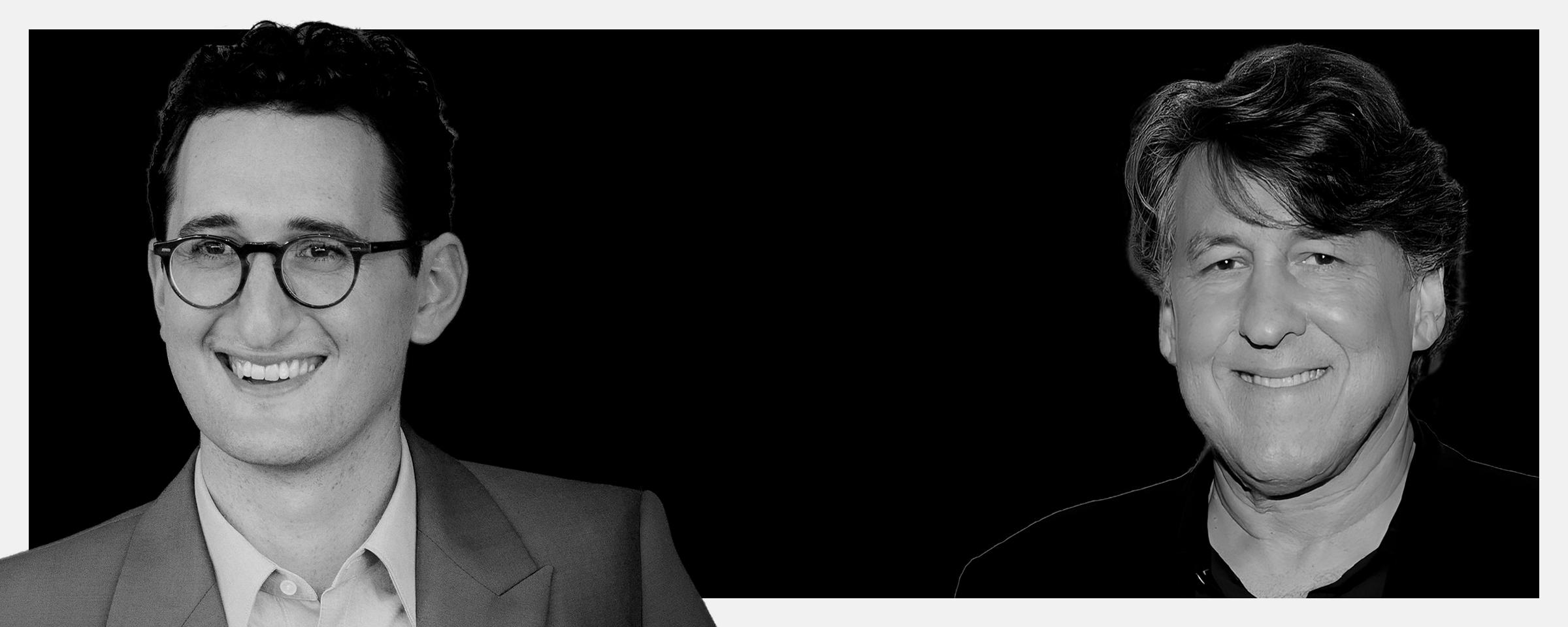
A soulful, cinematic conversation between Primetime & You Can See Everything director Lance Oppenheim and his hero, writer-director Cameron Crowe.
Topics covered include: Lance finding Cameron’s email thru the Sony hacks, watching Vanilla Sky over 100 times, Jonathan Lipnicki saving the production of Jerry Maguire, a shared devotion to the films of Billy Wilder, heightened versions of reality, Elizabeth Holmes as a human optical illusion, a fated night at the Magic Castle, regarding looks, witnessing Pedro Almodovar perform Prince songs at an afterparty in Spain, shooting 700 hours of footage for You Can See Everything, flesh impact, Sir Paul McCartney writing a title song for Cameron Crowe, shutting down Times Square for a single scene, the deeply personal ending of Primetime and wanting to talk to each other forever.
Lance Oppenheim: I'm Lance Oppenheim.
Cameron Crowe: I'm Cameron Crowe, and this is The A24 Podcast.
Lance Oppenheim: Okay. Where did we begin? I mean, I can't believe-
Cameron Crowe: With your amazing weekend.
Lance Oppenheim: Well, I can't believe that this is happening because... Okay, well, I guess you probably don't remember this. I hope you don't remember this because I found your email through the Sony hacks, and I wasn't sure if it was a working email, but I wrote an email to you, like a love letter, and I was writing it and writing it and writing it. And earlier that day or earlier that week, on Christopher Nolan's email too, and I wrote, "Dear Mr. Nolan," but I wrote this massive email for you, but I didn't change Dear Mr. Nolan at the top, and I pushed send. And I was like, "Oh no." I was like, "Oh, fuck.” I'm like, "I fucked this all up." I was like, "The person I've been dreaming of talking to..." I feel like this is... Where maybe it's worth beginning is I don't know if I would be making films without you because I saw Vanilla Sky when I was, I think, 11 years old, and it's the movie I've seen the most in my entire life. And it's the movie that made me want to make movies.
Cameron Crowe: Wow. Thanks, man.
Lance Oppenheim: I have this thing in my life, and I don't know if you've encountered this with people that have flocked to that one especially, but I can really weed out... David Bolen, my DP, we always say this: "If you love Vanilla Sky, then we love you." It's kind of like any person that loves it. I've seen Abre los ojos. I love Abre los ojos too, but I think maybe there's something in the... On the way over this morning, I was listening to “Last Goodbye”, the Jeff Buckley song. As a kid, that was the gateway door... It was the gateway drug to Radiohead, to Buckley, to R.E.M. I didn't see any of the movies you were referencing in the movie. So that's how I saw Jules and Jim. I saw all of these things because of Vanilla Sky.
Cameron Crowe: Clearly, we were making it for you because my dream was that all of those little Easter eggs and not-so-hidden Easter eggs would land with somebody like me, because all those things led to me wanting to make a movie about what happens if your life is made of pop culture. What is there? What is beneath all that? And I think that movie is an exploration of all that, but I love that you caught the spirit and the kind of elixir of that movie, because if you catch it, you catch it. If you don't, you don't. To me, it feels a little bit like the misunderstood child that grew up really well. I love hanging with that child. And so you summon all that stuff, and it reminds me of why I was so determined to make it exactly like that.
Lance Oppenheim: Well, there's something about it too that... Okay, well, a few things I need to tell you that hopefully will be interesting. So my office is on the street that Tom Cruise falls in DUMBO when the stitch happens. My office is there, and I literally would do... Because I got my start making documentaries and I feel like a documentarian, but I always was like, "If I could get Cameron Crowe energy into the stories of other people, then I feel like I would've succeeded in doing something." But one of the first short films I ever made was about my grandpa. He had dementia, and he didn't remember anything, and I was like, "I should just interview him and see what happens. I don't know." And my dad kept asking questions in the interview, and I was like, "Oh, it's actually more interesting to hear my dad off camera because he's sort of confronting him on his memories he doesn't remember." And then when he died, I found all of these Super 8 things. All these memories my dad had asked him about, that he didn't remember, had actually been diligently cataloged in some box somewhere in his apartment. I started editing this together, and I was like, "Oh my God, the things he didn't remember, he actually has documented." I felt like I was communing with his spirit when I was editing it. I literally took-
Cameron Crowe: You were, you totally were.
Lance Oppenheim: I downloaded Vanilla Sky. Again, I should say the way I found it too is my mom had a personal trainer at the gym who was like, "If you love movies, you got to see Vanilla Sky." So I owe it all to that guy. But I would take Vanilla Sky, especially the final sequence, when the Sigur Rós song is playing, and he falls off the building and all that stuff. I put it on the timeline and I literally just went bit by bit. I was like, "I'm going to take my grandfather's footage, and I'm going to see if I can match the timing and see how that would feel." If you watch this thing, you'll be like, "Oh my God, I just stole so much."
Cameron Crowe: I gotta.
Lance Oppenheim: How do you pronounce the “Ágætis byrjun?”
Cameron Crowe: I'm still not sure.
Lance Oppenheim: The Sigur Rós song?
Cameron Crowe: We were calling it “Number 12.”
Lance Oppenheim: “Number 12.”
Cameron Crowe: Because it was a bootleg.
Lance Oppenheim: Yes.
Cameron Crowe: But that thing is that it synced up with Sigur Rós so well and not with any other thing. It's kind of that deal like Hal Ashby showed Harold and Maude with somebody else's music, and it didn't have the same effect. But when he had Cat Stevens, it's like it blossomed and became that thing. And that was true at the end of Vanilla Sky, and it's made up of short films and stuff and Tom's family stuff and my family stuff.
Lance Oppenheim: And even that right there, I remember-
Cameron Crowe: Hugely emotional.
Lance Oppenheim: It's so emotional. I was just looking at it again. It's like one of those things: if I just throw it on, I'm not turning it off.
Cameron Crowe: I love that.
Lance Oppenheim: I think I've seen it over 100 times. I could probably quote things back to you that...
Cameron Crowe: You have a moment in Primetime. I have to tell you, there's a moment in Primetime that was that trigger that I wanted to have in Vanilla Sky, which is I always loved the line, "This is a revolution of the mind." I loved that so much. And if you don't have “This is a revolution of the mind” for me, you don't have a heartbeat that was necessary in Vanilla Sky. And I got that from Stone Phillips in Primetime.
Lance Oppenheim: No.
Cameron Crowe: Stone Phillips was like your, “This is a revolution of the mind guy.” And when I saw Stone Phillips, I would get that kind of, "Ooh, I'm going to the other layer."
Lance Oppenheim: Wow.
Cameron Crowe: And so it's so funny how those little pieces, those things that are important to you become important at the right time, which is how I feel about how you relate to Vanilla Sky.
Lance Oppenheim: Well, that's amazing.
Cameron Crowe: I love it, man.
Lance Oppenheim: Well, I mean, I feel like in Primetime there's all kinds of... I mean, it's funny. I actually found... I don't know if you remember this, but it doesn't have a lot of views on YouTube, but there's a Vanilla Sky... I've obviously seen the making-of documentary, which is great, but there's a world tour doc that seemingly Tom made, and he's wearing these sunglasses in the back of a car with Penélope Cruz.
Cameron Crowe: Hitting It Hard is what it became.
Lance Oppenheim: And there's a moment where he's breakdancing to the score. It's kind of almost melancholic music as this beautiful thing is happening. And I showed that to Rob, and I was just like, "This is kind of what we need to do." And of course, I think most... Maybe I'm making too big of a claim. I feel like most male actors now that I've met all relate to Jerry Maguire, and they want to do Jerry Maguire. And Rob specifically, it was almost like one of the things for the way we were depicting Chris in the movie. We were like, he's an underdog, and there isn't a... He's competing against Stone Phillips, and there's this kind of vampiric relationship to human suffering that a lot of these journalists would have back then, especially as post 9/11 and people were searching for the perfect receptacle for all of the anger and rage and fear in the air. I liked that there was this dimension of... It's like when Jerry hands the mission statements to everybody, and he's looking around, and there's this sort of unclear... It's almost like I always loved in Jerry Maguire too; that whole fucking opening sequence is so weird and so cool. I meant to ask you: there's a moment in the beginning of Jerry Maguire; it's so similar to when Tom in Vanilla Sky dies when he takes... And forgive me if people are watching this and I'm spoiling. I actually just went to look at this the other day, though, because in the beginning of Jerry Maguire, there's a shot of him, before he writes, he's feeling really fucked up, and it's late night and he kind of stumbles by a bar or something or by sink in his hotel. And then in Vanilla Sky, when he takes the pills, he also collapses. And I was like, I wondered if when you guys shot those two moments where you both... The thing I also loved, the philosophy of how you... I've read interviews where you talk about you're bringing the band from Jerry Maguire into Vanilla Sky, and they came together pretty quickly.
Cameron Crowe: That was the fastest between movies, I think, getting to Vanilla Sky. And we did Almost Famous between the two, but Tom's personal mode is so personal and intimate when you're able to use that. And Almost Famous was an intimate movie to me. So those are the moments where I feel like, "Wow, I don't care what anybody thinks about this. I know this is me speaking from a deep place that I really relate to." And Tom is able to catch that from the script and from me and present that in a way. So I really felt it was a direct line to the soul that I wanted to have in there. And I saw some stuff in Primetime where also he was so loose with you, and Cruise was the same way. Very early in the movie, when we were doing Jerry Maguire, he'd get loose with his body, or I'd say, "Why don't you fall down as you're walking through SMI (the sports agency)?” And he's like, "Okay, I will. Right on my face.”
Lance Oppenheim: Oh, it's the best moment.
Cameron Crowe: And that's when you know that you're shoulder to shoulder with the person that's telling your story with you, for you, and about you in some ways. Those kinds of relationships are so rare; you had it with Pattinson, and you could feel it.
Lance Oppenheim: Wow. That's nice to hear. I felt really... Yeah, Rob-
Cameron Crowe: And your DP who was there to deliver it too.
Lance Oppenheim: Yeah, David. You worked with- it was John Toll, right?
Cameron Crowe: It was Janusz Kaminski and Jerry Maguire, and it was John Toll in Vanilla Sky.
Lance Oppenheim: And John Toll did Almost Famous as well?
Cameron Crowe: He did.
Lance Oppenheim: Yeah.
Cameron Crowe: He did.
Lance Oppenheim: We got to talk about Almost Famous. But yeah, there's something that-
Cameron Crowe: Lance, we can talk about all.
Lance Oppenheim: I know, man.
Cameron Crowe: We got to get around to you.
Lance Oppenheim: It's also even funny, even the way this all came together, because Primetime, one of the eternal inspirations, was Ace in the Hole, Billy Wilder's movie.
Cameron Crowe: Fantastic.
Lance Oppenheim: And there was a documentary that I saw on the Criterion Channel that was sort of about Billy's last, I think, decade, and he still had his office. He was working on stuff. And then, of course, I was just like, "Wait a second. I've never read your book, Conversations with Wilder." And the whole thing of the way you got in touch with him and he didn't know who you were, and then you showed up at his office. I was like, "Dude, I hope I'm not..." I felt for a second, when I was trying to come to you, I was just like, "I hope you don't think I'm this weird guy that's..." But I was like, "Maybe he would relate to this because you are, to me, what Billy Wilder probably was to you." And also we even talk about Jonathan Lipnicki, who's obviously phenomenal in Jerry Maguire. And he came back; he returned to acting for Primetime, and it's a pretty tough part, I would say.
Cameron Crowe: Totally. Did you give him the job immediately or did you come in and have an audition, a meeting? What happened?
Lance Oppenheim: No. I saw a picture of him, and I read an interview with him, and I felt like he had more to give, and it seemed like he's gone through all kinds of stuff in his career. It's so interesting talking to him about Jerry Maguire, what you were just saying about Vanilla Sky, about how your life is made up of media. I feel like that's how... He's like my childhood. I don't remember anything, but I can see, and I see it in film, and I can experience it, but it's all a dream.
Cameron Crowe: Does he remember coming in for Jerry Maguire?
Lance Oppenheim: I don't know. What was that like? Because he came in for us, and I mean, talk about a committed actor. He knew the side of the street. He came in, and he was just so excited and Rob was so excited to work with him too. I remember we only had a day together, but I was just like, "I want you to come in here, and I want you to... This is a really intense, tough scene, but then when it comes time for you and Rob to be together, I want it to be a little loose and I want to just keep it going for a while, and I want you to watch a lot of these episodes and get yourself comfortable and familiar." But yeah, what was that like when you met him?
Cameron Crowe: Jerry Maguire is not the same without Lipnicki. Lipnicki came in and saved our ass over a weekend because I had cast somebody who was a first-timer, a kid from Seattle. And to me, that kid had a happy, sad quality, but he wasn't built for the long stretch. He wasn't really born to be an actor. And so after a few weeks in the middle of a scene where I think Jerry's drunk and he's in the living room, and I did four or five takes, and it was starting to get late, and the kid just looks off camera and goes to his mother, who's standing there and says, "I can't do this." It was so fucking real. Everybody in the room knew. There was no conversation. He can't do it and doesn't want to do it. I think it was on a Friday. We had to find a new person over the weekend. Madness, right? It was Gail Levin and Laurence Mark who I worked with. Gail Levin is my casting director for a long time. Laurence Mark was the producer and they're like, "We'll work all weekend." I was like, "The one thing is, I don't want a McDonald's kid. I don't want one of those kids." They come in early the next week, and they'll go, "Okay, we found a kid, and he's really good. So let's bring him in, let's put him in the trailer with Tom and let's work on a scene." Here comes Jonathan Lipnicki looking just like he is in the movie, that same haircut, glasses and everything. He walks in, and he gives Tom Cruise the Maverick thumb, and he goes, "You've been my favorite actor since I was a little kid." We looked at each other like, "Oh my God, this kid's amazing.” His one credit, a McDonald's ad. So you must abandon your early dreams and desires for what is really right.
Lance Oppenheim: Wow.
Cameron Crowe: And he had that magic with Tom. The human head weighs six pounds, eight pounds. That was his line.
Lance Oppenheim: No way.
Cameron Crowe: He came in with it. Yeah, he got it from a teacher. That's in the movie. It's like Penélope Cruz saying, "I'll see you in another life when we were both cats." That was her. I'm like, "It's in the movie."
Lance Oppenheim: That's amazing.
Cameron Crowe: I'll tell you about that. But Lipnicki-
Lance Oppenheim: Sometimes that will come in my head, "Cats, cats."
Cameron Crowe: “Cats, cats, cats.” Lipnicki rolls in and just aces all his scenes and became a spark plug. And all the scenes he was in, Tom has a little sparkle of like, "Holy shit, this kid has really got it. Let's do this again and have some fun." And I was wrong. You have to kind of throw your dream away sometimes or fight for other ones. But the idea that the kid couldn't be... In your film, you talk about, "Oh, that's TV. We're making TV. That's TV.” I didn't want it to be TV. And in fact, it wasn't TV. It was just the right actor for the part. And the fact that Lipnicki is in your movie, I love that. It's so great.
Lance Oppenheim: Dude, I mean, I'm astral projecting for a second as you're saying all this, because I'm just like... I can't believe I even get to be here with you, man. This is-
Cameron Crowe: I love it. We got to talk about your movie.
Lance Oppenheim: He's truly magic in Jerry Maguire. The whole movie is just... It's interesting because Vanilla Sky is about you're sort of trapped in a dream world. It's like the dream almost entombs you.
Cameron Crowe: Well said.
Lance Oppenheim: Jerry Maguire is like, it's actually very similar, but not literally that. The professional dream almost entombs him. It's like that happy, sad thing you're talking about. The movie is very melancholic, and re-watching it, I'm like, "This is a very complicated, emotional movie when he says I love you, but not enough for the both of us." But also the other great line, "You complete me." But the thing I love about it is I know he wants to believe in the love, and he wants to believe the idea that he could be anything and anybody else, but I also feel like he is Jerry Maguire. He's an agent. It's his dream. If I was a betting man and Jerry Maguire was a real-life person, I'd be like, "I don't know if that relationship lasted beyond the movie." At least the last time I watched it, I was like, this is so much more... It felt like demystifying in a way, what the very different forms of love, like a professional love, a personal love.
Cameron Crowe: Really well said.
Lance Oppenheim: Yeah. I don't know. But anyway-
Cameron Crowe: I love a love story. And the thing is, when we first showed Jerry Maguire, somebody in front of me stood up and proposed to his girlfriend right there.
Lance Oppenheim: Wow.
Cameron Crowe: And that was in that tender phase, like you probably have, showing both of these movies, Primetime and You Can See Everything. You don't know how it's going to land with an audience. And that's when I realized the love story was powerful. But to me, it's kind of like what you were saying. It could all disappear the next day with Jerry Maguire. Cuba could get injured. He could realize that it really wasn't the right love story for him, but for that moment, it was right. I like catching that moment, the fleeting, happy, sad thing. When Penélope walks into Brian Shelby's memorial that he's thrown for David Aames, and she walks in, and she's looking around, I’m born...
Lance Oppenheim: And she's got the tear in her eye. Yeah.
Cameron Crowe: ... to worship that kind of a moment. That's my favorite thing. And often we played the music that's in the movie.
Lance Oppenheim: Yeah, I wanted to ask you about that.
Cameron Crowe: I did it so much.
Lance Oppenheim: Where did that begin? And then also, were you ever like, "Fuck, I should have not played the music during this. I want to use the audio," or never. It really-
Cameron Crowe: Never, because we learned really early on. Jeff Wexler was the sound mixer. After one morning, we figured out how the dance would be. Cruise led the way too, because he loved having the music and he knew I would duck it out when it was time for the dialogue, but he so breathed the music in, and often it was the same music that's in the movie.
Lance Oppenheim: Wow.
Cameron Crowe: And I think we had a hand signal at one point where he'd be like [taps arm repeatedly] "Bring me the music." And so I had a cart, and sometimes I would do it myself. Sometimes it was Andy Fisher, a friend of mine we were working with. And it became this thing where the movie was coming alive with the music we were playing. Vanilla Sky, we were rolling all around New York with Kid A and Jeff Buckley and-
Lance Oppenheim: Rundgren.
Cameron Crowe: Todd Rundgren. Oh, that's-
Lance Oppenheim: I discovered Todd Rundgren through Vanilla Sky and through your movies.
Cameron Crowe: Well, this is great because I'm a Todd Rundgren fanatic.
Lance Oppenheim: Oh really?
Cameron Crowe: So the fact that we brought one more into the fold.
Lance Oppenheim: I produced this movie that I feel like you would love. It's called The Python Hunt, but they use “Tiny Demons” as the theme of that movie.
Cameron Crowe: That's great.
Lance Oppenheim: And I fucking love that song.
Cameron Crowe: Todd is a total genius.
Lance Oppenheim: But I mean, it makes sense that you do that. There's something in the movies, what Kate Hudson does in Almost Famous and what Penélope Cruz does in Vanilla Sky, and I feel like what Renée's doing in Jerry Maguire.
Cameron Crowe: All people who are music freaks.
Lance Oppenheim: You do this thing where there is a musicality of their movement, and there's also... Each of them gives looks, I mean, Tom for sure does it. I just keep thinking it's like X-rayed in my head when he first gives her the look when she's drawing him. And I actually don't think I've ever experienced... It's like a heightened version of reality, and it's like what you want your life to feel like.
Cameron Crowe: But it is how it feels.
Lance Oppenheim: It's how it feels. Yeah.
Cameron Crowe: When you meet somebody that's going to matter to you, sometimes you see it very instantly. Tom, when Renée first walked into the room, Tom, the actor, saw Renée, and it's on video, and it's that thing. I love living in those moments. It's everything. And you have such an amazing use of close-ups and stuff. You Can See Everything is an accumulation of looks for me. Nathan is the Beethoven of looks.
Lance Oppenheim: Nathan wasn't going to be in the film for a while. When it first materialized, it was really funny because I feel like Nathan and I both were like, we met, I cold emailed him too actually, because I saw he watched my first film, Some Kind of Heaven. And I feel like both of us were sort of interested in the challenges of capturing authentic life. The way I do it is sort of what you were just talking about: this kind of inhabiting a subjectivity, or just I'm less interested, I guess, in the raw reality. I think it's almost impossible to ever capture something objective in a movie. And I don't think that's... I mean, look, I love Frederick Wiseman's movies, but even when Frederick Wiseman talks about his documentaries, he refutes the label of a documentary. He calls them drama films or actuality films. I always thought that the non in nonfiction is such a reductive idea. So in the earlier films I made with Some Kind of Heaven and Spermworld, Ren Faire, I was always interested in what happens if you try to use all of the cinematic tools, the toolkit, to tell a truth, their truth, but also try to inhabit it subjectively.
Cameron Crowe: It's so exciting.
Lance Oppenheim: With You Can See Everything, it was really different. I essentially had to unlearn a lot of the ways I made a film because I felt like Elizabeth was almost this... She was a human optical illusion, and using tools or using things to inhabit that wouldn't have worked. If anything, Nathan and I were basically like, we have to forget everything we've ever done individually, and we have to find a new way of working, which ironically was actually the oldest way of working, a vérité film and just watching. And then how do you... Okay, so, we're working with cameras, big cameras, ALEXAs, you know, cinema cameras. And I kept saying, "Look, the face, that's what matters here. Seeing how they operate, seeing what they do with their everyday lives, that's interesting to me."
Cameron Crowe: Are you in the room with them directing?
Lance Oppenheim: I'm in the room. I'm not directing them ever. I'm-
Cameron Crowe: But just knowing the shots you want?
Lance Oppenheim: Yes.
Cameron Crowe: How do you let them know?
Lance Oppenheim: Essentially, what we would do is we would figure out the right places where the cameras should go. There'd be one camera in their kitchen, kind of looking towards the back half of the house where the windows are by the beach. There's another camera by the fireplace, a wide camera, like a 12-millimeter. I'd usually be behind that one. And then there'd be another camera on the opposite side because the house was small. But at the beginning it wasn't like that at all. At the beginning we didn't know... This thing came together so quickly. We really didn't know how or what we were doing. And initially it was one camera, and we kept missing... We would pan and swing. There'd be an interaction that would happen, but we would miss the first reaction to a moment. I think Nathan would be like, "That's the whole thing." It's like these are the moments that we need to be on somebody for. So we then went to two cameras, then eventually three. But Nathan was not intending to be in this until the first day. When we got there, they kept asking him questions, and it felt like they were drawing him in from behind the camera, in front of it. I think Nathan originally was just like, "Let's just see if we can observe them and see what would happen." But then at some point it was like, actually, that's good because it felt like she was living in her own... She even describes it like it's a different version of reality. And it felt like we needed something. We needed somebody to come in and kind of confront her on that, maybe some of the delusions she has or see if he could bring her into the reality we were in. And then he almost became... Then it was like, oh, it's almost like a detective... It felt kind of like a detective film. He was this amateur investigator into these everyday moments. And that was really cool.
Cameron Crowe: How early was the egg whipping?
Lance Oppenheim: That was early. That was in the first several days. And that was a big moment for us too where we were like, okay, so there's something in this relationship that's... And it goes back to the questions of love and that stuff. I saw this documentary about John Cassavetes while he's making Love Streams, and he talks about all of his movies are about philosophy, and he's like, philo-sophy is like philo-love and sophy a study of love. And he's like, when you have it, when you don't have it, when you want it, but when it doesn't want you. He said this beautiful thing like that. And I was like, you know what? I relate to that. I think about that my entire life. I feel like my entire life is defined by that similar questions. When I think about your movies, I think that's why they hit me like a sledgehammer as a kid and as an adult, because it's all about that. It's like, are you willing to live inside a dream world that could become a nightmare at any point in time just so you could be with this person that you only spent five days with? Or-
Cameron Crowe: But love lives in all of these different ways. I mean, there's no greater subject.
Lance Oppenheim: One of the great things about making that film was the way we're talking about it is exactly the way I would talk about it with Nathan and David Bolen, who shot it and Abby, my wife, who produced it and Tatiana, my whole crew, Jonathan Mitchell, Adam, who cut it, Richard, my sound... It was like every person who worked on this would just argue about these moments, and literally right after they would happen.
Cameron Crowe: This is heaven to me to hear this. To have a team like that?
Lance Oppenheim: It was incredible.
Cameron Crowe: That you can just think tank with as you go on.
Lance Oppenheim: Well, I always thought about, again, just the way you talk about making Jerry Maguire into Vanilla Sky, I was like... You Can See Everything started three and a half years ago, and Primetime started two and a half years ago. It's the same team that made both films for the most part. David Bolen, DP, shot both. Ari Balouzian did the score for both. My wife worked on both. Christian Vasquez, who I went to film school with, my producer, he worked on both. So I felt like I had a lot of the same spiritual DNA between both movies. And I kept thinking about just that philosophy that you have. You find a good group of people that you like making movies with. That's like your family, and you keep going with them.
Cameron Crowe: It's so true. We took Vanilla Sky to Spain, and I showed it in Spain. My grandmother was from Santander, Spain. And so I got up there and introduced the movie, and I'm like, "My grandmother is from Spain." And they're like, "You're not the first director to come and try and drop some Spanish cred. Show the movie." And afterward, I realized Pedro Almodóvar was there, and he had this party, and it was all of his people, all the people he makes his movies with. And he's got a guitar, and he's singing Prince songs. And I'm going, "Where is this pod of human existence that I can travel and do all these movies with?" But I take too long to write scripts sometimes. And Vanilla Sky was an opportunity to punk rock it. Tom wanted to go. He had a window. We saw Abre los ojos. He's like, "I'm ready. Let's do it." So I jammed out that script really fast because I wanted to be the rock pop culture cousin of Abre los ojos. And there's things that happened in that movie because it was made so quickly and because we were on the gust of wind of Radiohead and Red House Painters and all the stuff that's in the soundtrack was our soundtrack for making it.
Lance Oppenheim: Speaking of soundtrack, you know that there's a rapper, Big Sean, who is signed to Kanye West's label-
Cameron Crowe: Yeah. Yeah. Yeah.
Lance Oppenheim: He samples Julie Gianni's song. Do you know this?
Cameron Crowe: Yeah. I do know that.
Lance Oppenheim: What the fuck? I think the song's called “Jump Out the Window.” I actually love Cameron Diaz's Julie Gianni song in the movie too.
Cameron Crowe: Me too, me too.
Lance Oppenheim: I actually listen to that. [Singing]. I love it.
Cameron Crowe: I love it.
Lance Oppenheim: It's great, but what a crazy...
Cameron Crowe: It's crazy.
Lance Oppenheim: Isn't it cool how... I mean, I feel like, weirdly, Kanye, I remember “Through The Wire,” he mentions Vanilla Sky too.
Cameron Crowe: He mentions it too. Yeah, I love it. Vanilla Sky found its people.
Lance Oppenheim: The way that even the end of the movie, it goes back to Jerry Maguire, and I think even in Almost Famous, just them and the airplane, and they're missing each other. There is this thing that I fucking love so much about your movies that... And Say Anything's the same way too. There is this... It's really-
Cameron Crowe: You're firing me up.
Lance Oppenheim: There's a melancholia to all of it.
Cameron Crowe: You're moving up the production schedule on the next movie just by talking.
Lance Oppenheim: We need it. I need it so bad. I need it so... Well, because I think there's something in the fact that he chooses to wake up at the end of Vanilla Sky and not stay in the dream is actually a kind of anti-romantic idea. And for all these movies that are about love, they're pretty sobering at a certain point too.
Cameron Crowe: Sobering is a good word.
Lance Oppenheim: There's something that I love. It's like the sweet and the sour as it goes in Vanilla Sky, but there is something that I just love about that. And that's what gives it staying power in my mind is the fact that he-
Cameron Crowe: I have more for you.
Lance Oppenheim: Yeah, that he chooses to wake up and chooses to leave the dream.
Cameron Crowe: A couple things about that, but I have to go back. The amazing thing, too, that I was thinking last night was Billy got his dream, right? Billy got... Might be Elizabeth's dream and Billy's dream, but the dream to reorganize and reshape the vision that everybody has of Elizabeth Holmes happened. You're not going to think of her the same way that you would've thought of her a couple months ago. They're involved in this Byzantine kind of amazing film now. So they've got kind of an allure and a mystery, and they're elevated, and she's not just to be thrown on the waste heap of pop culture. She's like, "Well, you got to think about her."
Lance Oppenheim: I mean, that's interesting.
Cameron Crowe: And Billy.
Lance Oppenheim: Right. Right.
Cameron Crowe: It's like, how else would you have been able to do this?
Lance Oppenheim: It's shocking to me. And I mean, the one thing I love about the film is ultimately as it kept... Because the whole thing, we didn't know what was going to happen. How it started was so random and strange. I was at The Magic Castle with Nathan here, and he's a member of that place.
Cameron Crowe: I love that it starts in The Magic Castle.
Lance Oppenheim: Someone in the close-up magic room, the magician asked for a celebrity name, and someone said Elizabeth Holmes. And earlier that day I had heard that A24 had been approached by her. She wanted to work with A24, and I was like, "Why?" And I heard that she wanted to have a documentary crew come in and film her last days. And I had read Bad Blood, and I had listened to the podcast. I'd seen The Dropout, and I was like... It's interesting because she never had participated in any of those stories. She didn't participate in John Carreyrou's reporting of the downfall of the company. So I was like, "Why now? What does she have to say? What does she want to show us that's so interesting or show A24?" And then Nathan called A24, and then a lot of things just started... Literally, I think maybe within two weeks we were just there.
Cameron Crowe: Wow.
Lance Oppenheim: And Nathan was without a fishing net. He was working with a crew he'd never... He brought in Jonathan Mitchell, who's an incredible camera operator, and eventually Eric Notarnicola, who's an incredible producer that he works with, and Adam, his editor. But in terms of the actual physical production, it was really like you're working with... I was like, I want to bring my people in. I'm going to bring David in. I'm going to bring Ari in. I'm going to bring David Shane and Christian and Abby and Tatiana Bears and Jack Davis. I had a whole crew of people. I was like, "I want to work with these people. I've known them for forever. I'm making films with them forever. Let's see what happens how we marry these things." And it felt like the whole movie- it's really later on, as the reenactment stuff start- that's a different story. But for the most part, outside of that, all the documentary stuff is seven people. It's a crew of seven, and there's no artificial lighting sources. It's all practical lights. It's all natural light. David is just a master. And even after doing that, and then the first part of the movie, in that two-year period when we were waiting for Billy to call us up with the prototype, is when I went and made Primetime. And then we'd go back when You Can See Everything started, and we'd be back in this really kind of the ultimate documentary athletic experience where we would sometimes shoot up to 16 hours a day. We literally shot 700 hours of footage for this movie. And Nathan the other day asked Adam, who edited it, "Do you think that what we made is representative of all 700 hours of material?" Adam was like, "I think so." It's so interesting, when you think about it that way, there's some stuff I was just even looking back at where it's like for long stretches of time, just nothing would happen. We would just be waiting, seeing what they would be doing, responding. It almost felt like Solaris, both versions.
Cameron Crowe: Interesting.
Lance Oppenheim: I love the Soderbergh one, maybe more. I know it's blasphemous to say this, but the Soderbergh one is closer to me, but I always loved... It's like you're looking at something that is looking at you, and it's changing something in you as you're attempting to observe it. That's how I felt the entire time. Okay, but I want to ask you another question about... The reason I bring up those looks in all of the movies, there's something about in Almost Famous when Kate Hudson is traded to the other band for some beer, and she gives this absolutely devastating look and the sound drops out, and then there's a hard cut to the plane full out... And you do this actually a few times. Is that something that you felt conscious of as a trademark as it went on, or was this just this direct-to-camera, kind of just like... Penélope Cruz, I was trying to figure out where it was in Vanilla Sky. When he realizes he's, right after the accident and they're in Central Park, and she looks at him and the camera's kind of gliding away, is that something that you're like, "Okay, let's do that here."
Cameron Crowe: Yeah. And I also like playing around with looking into the lens. That's always great. I've loved that ever since Harold and Maude when he finds the camera, and you're like, "Oh my God, he just broke the wall," but in a really kind of intimate way, not-
Lance Oppenheim: Who were your guys? Ashby?
Cameron Crowe: Ashby, Truffaut. I love Bill Forsyth, Local Hero. That's just wonderful, that's like a marriage of music and film and stuff. And Wilder. I just love Billy Wilder, obviously. But the thing is, I love those old movies that have regarding looks. Cary Grant really was the king of the regarding look. And I realized, and this is a big motivation when I'm making a movie, is we are the person who's observing the person. So Cary Grant wants you to love Katharine Hepburn. You, as the director, want the audience to love Katharine Hepburn, but you'll never love Katharine Hepburn as much as when you watch Cary Grant regarding her. And the way he looks at her, we fall in love with her. Warren Beatty does this in Bonnie and Clyde, and it's an almost-kiss where he's looking at her. And when the kiss happens, it's not as powerful as the look before the kiss. In the same way, Spielberg, the monster in the window isn't as powerful unless you've got the kid looking. And so that's like love for me on film. So if you have the regarding looks, the right regarding looks, you can dial it however you want to dial it, and music helps you too. Cruise is a master of the regarding look. He does a whole bunch of it in Digger. You really have to have somebody who's invested and really with you to get what you're trying to get across with a look. I'll do it all day long. They have to pull me off the set because I love the looks between the dialogue, and it's my favorite thing. The other thing they tried to pull me away after I did it too many times was in Jerry Maguire when Cruise is out on the walkway, and he goes, "Hey, I'm back." I couldn't get enough of it. It's a little bit like Risky Business, and he's going, "Hey, I'm back." And he's loving doing it, and I'm loving doing it. Finally, someone just has to whisper to me, and say, "He's back, okay? He's arrived. It's all right. Move on."
Lance Oppenheim: You wanted him to have his revenge as many times as possible.
Cameron Crowe: Yeah.
Lance Oppenheim: I fucking love this scene when he realizes he's getting fired too, and how that scene is so unnerving. I remember there's something in the water, right?
Cameron Crowe: Yeah, the ice tingles.
Lance Oppenheim: Yes.
Cameron Crowe: So sound is super great. I watched a documentary that Scorsese did about George Harrison the other night, and he does this move in the beginning where he's playing the George Harrison song “All Things Must Pass” while showing bombs dropping in George Harrison's childhood. And I think he does a piece of The Beatles breaking up, and it's all just to this song, and it's different times happening, and then it's to silence. And it just jolts you into the next thing, and you're totally paying attention. And that's the most fun for me. What's the most fun for you?
Lance Oppenheim: Shit, man. Well, I mean, I do love Ari, my composer; anytime he just gets into something, it's incredible because he has such an idiosyncratic brain for things. There will be references that I don't know, things that are not even conscious that he'll just bring into it. And I always love this idea. All the other documentaries, I guess maybe to some degree You Can See Everything has this too, but I was always like, what if you take human drama and you make it feel like Hollywood drama? And I felt like Ari is the perfect person for that. And on set of Primetime, I would play Rob some of the demos and stuff, and I was thinking about stories, what you would do. And I have the videos even of Rob being like, "Give me that one thing one more time." And Rob's a musician. He's very musical, very musically-inclined. Even the thing you were just fucking talking about with these looks, I actually really, I went back and did some pickups just to get that because I felt like I missed-
Cameron Crowe: On Primetime?
Lance Oppenheim: On Primetime. I had an incredible script. I had a great screenwriter I'm really close friends with, Ajon Singh, who wrote this on spec, and then I got involved in it. This was his baby, and then we reworked it together quite a lot, and we wanted it to kind of enter this more spiritual register and more of a fever dream. And I also really wanted it, my editor, Dan Garber, I would show him Vanilla Sky, and I would show him, he watched Natural Born Killers, and I showed him Demonlover, the Olivier Assayas movie. And I was like, I want this to feel the things that these movies have in common, they're all media collages, and I want this to have that kind of the consciousness of the characters is emanating from the world that they live in, and that world is sort of ours, but it's also something different. But Ari-
Cameron Crowe: You do that in your quick cuts. You do that so I think lovingly that it never feels like slice and dice. It's just like, okay, this is what you're feeling as the filmmaker. This is your brain firing with me.
Lance Oppenheim: Yeah. I love that. On Primetime, Dan, in the way he was able to create this very special language, there are times where I felt like I was so interested in just sort of finding something real that I would constantly just kind of throw things at the actors. I remember the day with Jonathan and Rob.
Cameron Crowe: Do you talk during scenes?
Lance Oppenheim: Sometimes. The thing that I really loved, though, is I was able to, like... With Merritt Wever and Skylar... There's a scene between Merritt Wever and Jessica Hecht, and we shot the scene, and I was like, it was good. I really liked it, but I was like, I want... So I just got in there and would do what I would do on the documentaries, like in Some Kind of Heaven and Ren Faire or in Spermworld. You Can See Everything was different, so I didn't do it for that as much. But on those films, the first three, I would go in, and there'd be two people talking to each other, and I would just essentially interview. I'd interview them through each other. So I did that with Merritt and Jessica Hecht, where I was like, "Okay, maybe Jessica Hecht, maybe you could talk about Supernanny and how that was... Your experiences on Supernanny and making the show The Nanny has equipped you with a specific set of skills and knowledge that you can impart to Merritt." So there's so much improv, but I didn't get enough fucking looks, and I went back and did some pickups just to get those looks. And there's certain things, this wasn't from the pickup, but the most Jerry Maguire moment, I think, in Primetime is he goes, "Nothing I do is acting, Dan." When I see that, I'm like Rob is so... And there's another scene where Rob and Anna Faris are together, and she was so great and special to work with too. And the speech when he's like, "I will be the man you married." There's something that's so also Tom about it too. And I love that Digger came out-
Cameron Crowe: Tom and Jason.
Lance Oppenheim: Yeah. I thought Digger was such a special, fascinating trip. It was fucking crazy and so cool to see all of these great people come together and make something as loud and fucking insane as that movie was. And I was like, it's so cool that Primetime came out the weekend before Digger.
Cameron Crowe: Amazing.
Lance Oppenheim: And I felt like Primetime, Rob is doing, I felt like a little bit of Tom.
Cameron Crowe: I love that you think this. Yeah.
Lance Oppenheim: And I felt like Tom in Digger, he wasn't doing a Rob thing, but there was almost like, it reminded me a little bit of Rob in Mickey 17, maybe where he is kind of unrecognizable and the voice is so different. And I loved all the stuff in Digger where he's talking about just this sort of meta... I hope I'm not spoiling it for people, but it's been out now. But I love the scene when he first exits, and he's like, "What the fuck am I doing? Am I doing a cartoonish version of a real person?"
Cameron Crowe: It's so good.
Lance Oppenheim: And I actually thought even that conflict for Tom's character, what we were experiencing on You Can See Everything was we were like, shit, we got to make sure that... There are moments we never were able to capture. And after we shot the first half of that movie, I was like, "I don't know where this is going to go, but we need to see where the business goes." Business comes up, starts shooting that. We're like, "Okay, a lot of weird things are happening, but we have no one to talk to about this." We tried reaching out to a few people, including John Carreyrou, who wrote Bad Blood, but didn't work, and no one really wanted to talk to us because she has such a toxic reputation. Amanda Seyfried was the one person who really said, "Yeah, I'll talk to you guys." We didn't know her. The first conversation, basically no agents, no managers. She was flying home from The Testament of Ann Lee, premiered at Venice, which a great film. And she was like, "Just come to my house. Set up, and I'll see you guys there."
Cameron Crowe: Wow.
Lance Oppenheim: She left the door unlocked, or she had someone unlock the door. We get to her house before she even fucking arrives, and we just basically start filming them just like we did with Elizabeth and Billy. There'd be days in their house where we were like, okay, we're going to go into their house before they wake up, and we're just going to have the cameras set up and rolling. So we did that with Amanda, and the first time we ever met her was-
Cameron Crowe: Is when she's watching the-
Lance Oppenheim: Yeah. And we never thought... It was a godsend, and she really saved our fucking asses, just like you're saying Lipnicki did.
Cameron Crowe: She gives you a totally... That's incredible.
Lance Oppenheim: We didn't think she would... It came from her, the idea of wanting to do it again.
Cameron Crowe: As Billy Wilder would say, "This is a gift from God."
Lance Oppenheim: It was a gift from God, absolutely. And I bring this all back to Digger because I was like, we were like-
Cameron Crowe: It's a good weave, man. I'm following you.
Lance Oppenheim: Yeah. When we were trying to do, when we were like, we have to get the right... We have a responsibility as filmmakers. There are events that happened that really, as the experience of the movie went on, we were like, shit, the movie would be incomplete without being able to show these things.
Cameron Crowe: Amazing.
Lance Oppenheim: And when Amanda, when that opportunity availed itself to us, it was like, okay, well then how do we get this right? How do we capture this feeling, this sense of... It's almost like channeling or something. It's less of doing a performance. I mean, certainly that's part of it, but it felt like, watching Nathan, even see it in one of the scenes where he's like, "It's not like that." And then he kind of is thinking, he goes, "Try it again." And she does it, and he goes, "Yeah, that feels right."
Cameron Crowe: That's got to be agony for an actor too. It's like, "Close enough." She's so human and real.
Lance Oppenheim: She's amazing.
Cameron Crowe: The person sitting next to me in the theater when she says, "It's kind of controlling." It was like, "Yes, yes, yes." It was like a three-act yes.
Lance Oppenheim: She just brings in a whole host of her own things.
Cameron Crowe: Do you script any of her talking about the stuff? Not the recreation.
Lance Oppenheim: No, all real.
Cameron Crowe: So that’s all real? Her conjecturing and theorizing and stuff is all real. Amazing.
Lance Oppenheim: And we had to develop a system too, because she's someone who wants to know, "What am I doing? Where am I going? What's happening?" And we had to be like-
Cameron Crowe: And you were on it.
Lance Oppenheim: "You just have to come, and we're going to figure it out."
Cameron Crowe: It's so winning. It's so winning.
Lance Oppenheim: And so you see, obviously we gave her the scripts based on her memories of the reenactments.
Cameron Crowe: Sure. But her other stuff is so insane.
Lance Oppenheim: That's her.
Cameron Crowe: That's amazing. Okay. I have to talk to you about Phoebe Bridgers.
Lance Oppenheim: Oh, dude. Yes.
Cameron Crowe: Fucking amazing in Primetime. She is so comfortable, and so, I felt like, oh yeah, she and Lance are buds. It's obvious. She's so on your wavelength, and just like the fucking Nine Inch Nails joke. It's like...
Lance Oppenheim: That was improv.
Cameron Crowe: ... oxygen, man.
Lance Oppenheim: That was improvised between her and Bokeem just in the moment.
Cameron Crowe: She's so good. She has the Billy Wilder thing of, "Put the camera on her.” And Nathan.
Lance Oppenheim: She's got a very strong screen presence. And I've now done two music videos for her.
Cameron Crowe: I know.
Lance Oppenheim: And I fucking love...
Cameron Crowe: She's great.
Lance Oppenheim: I love seeing her on camera, “On Video.” That's the name of the song, so I guess I'm referencing that. But I love watching her do... I could watch her just read the phone book. You know what I mean?
Cameron Crowe: Did she ever talk to you about Joni Mitchell?
Lance Oppenheim: Oh, no.
Cameron Crowe: She was part of one of the Joni Jams that Brandi Carlile staged in Joni's house, bringing Joni back to music. And Brandi was really brilliant about bringing certain groups of musicians into Joni's world. And Joni was just coming back to her life, really. And she'd sit in a big reclining chair with her cane and be a part of what people were really doing, which was reintroducing her to her own music often, which she was starting to remember and feel again. And people were passing around instruments and playing songs, and it came to Phoebe, who Brandi had brought to one of them. And she said, "Well, this is kind of dark." She played one of her songs, and Joni was just watching and kind of taking it in. And you could tell she's saying, "Well, this is the future." She's looking at Phoebe. It was beautiful to see, but it was really quiet. And then it moved on, and somebody said later, "Phoebe, yeah, did you read on Twitter? David Crosby really came after you for acting up in your SNL musical segment. Was that really necessary?" And Joni sits up like, "David Crosby was pissed off at you?" And she's like, "Yeah." And she goes, "You're great. You're incredible. That's so funny. I love that. I love that." And you can see Phoebe's just like, "Yeah, sister, we take care of business out there. Come on."
Lance Oppenheim: Wow.
Cameron Crowe: And they fucking bonded, and it was so beautiful to see. And she had her own little world there, was kowtowing to nobody. And I just felt like watching your movie, I'm like, she has so much going on, and there's more for you guys to... Don't you think? You've got to work with her some more.
Lance Oppenheim: 100,000%.
Cameron Crowe: You guys have a thing.
Lance Oppenheim: There was one other-
Cameron Crowe: I have a Vanilla Sky thing to tell you.
Lance Oppenheim: Oh yeah, please, please.
Cameron Crowe: I just thought of this because one of the Joni Jams, Paul McCartney was there because I guess Brandi knows Paul McCartney. And I hadn't seen him since Vanilla Sky. Actually, I saw him after Vanilla Sky, right before he got -
Lance Oppenheim: Loved the song, by the way.
Cameron Crowe: Me too.
Lance Oppenheim: Fucking perfect song.
Cameron Crowe: And he got nominated and I was really, really happy about that and everything. So I see him at the Joni Jam, and he was like, "Hey, how you doing?" I was like, "Yeah, pretty good." And he goes, "I saw your movie Vanilla Sky the other day. I still don't understand it, man. I still don't understand it, but good for you." And I'm like, "3:00 AM, check it out again sometime if it comes on; it might be your time to get it." And he was like, "Yeah, man."
Lance Oppenheim: I don't understand how people... Well, that's fucking amazing. And the song he did, [singing] “Don't blow it away”
Cameron Crowe: I love the song. He caught it perfectly.
Lance Oppenheim: Yeah.
Cameron Crowe: He was going to give us a song from an album that had just come out, and I haven't really talked about it that much, but he came in, and we showed him some reels of Vanilla Sky, and he caught the vibe of New York and that thing we were talking about earlier. The time, that one time before 9/11 and everything, he saw the elixir of it. And he said, "Yeah, use any song from the album." I said, "Well..." Knowing that Vanilla Sky was kind of a Beatles- oriented title, but I didn't tell him that. And David Aames lives in The Dakota, so he saw this stuff. He probably put it all together, of course. But I said, "If the inspiration strikes you, write a title song." And he was like, "Ha, ha, ha," and left, and I'm like, "Fuck." I made him feel like his album wasn't going to be as good as a title song, and I felt kind of bad. And then the phone rings a couple days later, and it's McCartney who talked to Danny Bramson, my buddy and the music supervisor. We did all this stuff together at that time. He was like, "Watch what you ask for, because you're going to get it. Come on over to the studio and hear my song." And we're driving over to the studio here, and it's like, "Oh my God, what if it's not right for the movie?" And we're like, "Just feel good. Just feel good, man. Just feel good. It's going to be good." And he plays us that song, and it was perfect. It was perfect. And he said, I think that he had had dinner at an Indian restaurant, and he had a feeling for what the song would be. And I had told him, actually, when I asked him to write a song, maybe, called Vanilla Sky, I had mentioned the acoustic vibe. We had used acoustic stuff in Jerry Maguire. I was like, "Man, maybe it's going to be an ‘In My Life’ kind of a vibe," even though that's a John song. But I was so happy that it fit the movie perfectly.
Lance Oppenheim: Yeah. And it shares some of the motifs of the score too.
Cameron Crowe: He nailed it. He nailed it. To realize that he's still out there trying to fully understand the movie makes me love him even more.
Lance Oppenheim: That's so awesome. The song is perfect in the way it hits. It's like you hear the breathing and then it's just immediate. There's no cut to black. It's just, "Written and directed by Cameron Crowe," and then you hear the first, the strumming of the guitar.
Cameron Crowe: And the end of the movie was huge for us. So much of the kernel of what it is going to be present.
Lance Oppenheim: Who does the voice? Can you say it?
Cameron Crowe: Yeah, I can say it. It's an actress we really loved and wanted to put in one of our movies named Laura Fraser.
Lance Oppenheim: Wow.
Cameron Crowe: And we loved Laura Fraser, and it was like, "Okay, well, David Aames comes back in another world, and it's that character that we didn't quite find a place to put in any of our movies. It's Laura Fraser."
Lance Oppenheim: Oh my God. Okay.
Cameron Crowe: And that was the thing.
Lance Oppenheim: That's actually so interesting because usually sometimes I would watch the whole movie and each time I'd watch it, I'd be like, "It's Penélope, it's Cameron."
Cameron Crowe: Some people think it's Cameron Diaz.
Lance Oppenheim: They sound similar.
Cameron Crowe: And they do sound similar, and that's intentional.
Lance Oppenheim: I love that it... I love that.
Cameron Crowe: But it still leaves the whole thing open for interpretation.
Lance Oppenheim: Definitely.
Cameron Crowe: I have to say, I'm not quite in this vein anymore, but for a long time, I thought the movie was Brian Shelby's novel.
Lance Oppenheim: Yeah.
Cameron Crowe: I thought the whole movie was the kind of thought-out, but not totally thought-out, shaggy novel that Brian Shelby comes up with in the shadow of David Aames. And I liked that for a long time, but I've drifted over into another point of view.
Lance Oppenheim: I love that. I've also seen the theories.
Cameron Crowe: Because of you, I think.
Lance Oppenheim: Wow.
Cameron Crowe: I think in the last day or so, I've really been thinking about it. It's like, I think I'm going to go back to my original thing, which is...
Lance Oppenheim: Yeah. Well, for some reason, for me, I've never wanted to believe. I've seen the theories, and there was times where I was like, oh... I remember literally at my Bar Mitzvah after-party. I showed them all Vanilla Sky, and I remember being like, "Look at the license plate on the Porsche at the beginning. The numbers are... It doesn't make sense. It's all a dream." But then I was like, "You know what? I choose to believe." And I've seen all the deleted scenes. I love the deleted scenes, by the way. I love the shootout in the... I fucking love that.
Cameron Crowe: Yeah. I love that too.
Lance Oppenheim: Also, Kurt Russell, man. We have to give him some-
Cameron Crowe: Thank you. I was going to bring that up.
Lance Oppenheim: He's fucking... And Michael Shannon, who's in the scene.
Cameron Crowe: And Michael Shannon. Kurt Russell, so amazing. And if we're collecting moments from Vanilla Sky that we like, and I love doing this with you, I must say, Kurt Russell, realizing that he's not real.
Lance Oppenheim: Yeah. I literally just watched that.
Cameron Crowe: Maybe my favorite thing.
Lance Oppenheim: "I'm real."
Cameron Crowe: "I'm real."
Lance Oppenheim: Yeah.
Cameron Crowe: "I've got two daughters."
Lance Oppenheim: Yeah.
Cameron Crowe: I love it so much. And all these people came, Lance, to really give it up.
Lance Oppenheim: What's his line again? He goes, "Reality as home entertainment? This cannot be the future."
Cameron Crowe: "This can't be the future. Reality as home entertainment?"
Lance Oppenheim: Yeah.
Cameron Crowe: "This can't be the future." Of course, it is.
Lance Oppenheim: Yeah. And his look, and then he looks at Brian and then-
Cameron Crowe: I know. I know. It's so great.
Lance Oppenheim: Also, did you see that I had to throw in the My Name Is Earl image of Jason Lee-
Cameron Crowe: Yes. It's so great. I love it.
Lance Oppenheim: ... just because I was like... Dude, I mean, Jason-
Cameron Crowe: I love that you threw that in there.
Lance Oppenheim: ... in all of your movies is also just... Okay. I wanted to talk a little bit... I want to talk about Almost Famous too, but yeah.
Cameron Crowe: Before we talk about Almost Famous, I just want to say, I'm realizing now in the alternate reality post-Vanilla Sky that I think if I go back, I realized I knew I was making the movie for you in the future. So it found its home. It found its home.
Lance Oppenheim: Wow. Dude, that is so special. I always remember... Okay. A few more questions about it and then we can go to... The trailer for Vanilla Sky.
Cameron Crowe: There was the scene. The scene was when you got out of the elevator this morning. I was like, "Yeah, it's for Lance."
Lance Oppenheim: Yeah. Wow. The trailer for Vanilla Sky and The Chemical Brothers' song, “Where Do I Begin,” that had one of the most profound... And the texts, forget about love, life, sex, all that. And then it's, "Just open your eyes," and you see the nightclub scene and the face. How-
Cameron Crowe: We also hailed Joni Mitchell in Vanilla Sky, which... Yeah.
Lance Oppenheim: Oh, yeah. Yeah, you're fucking right. How did that... And Spielberg's, I love Spielberg's cameo too.
Cameron Crowe: Spielberg.
Lance Oppenheim: The marketing of that and the rollout, I want to know how you felt about it right when it came out because it was a huge hit. And one of the things that I think also made me be like, "You know what? This is my fucking movie," and I was curious if you were feeling... Because critically, it didn't get amazing reviews, which, to me, I was like, why? Because you'd see that movie. I think that movie came out now. I don't know if it was ahead of its time, or something like that, but it also feels timeless. You know what I mean?
Cameron Crowe: Thanks, man.
Lance Oppenheim: But what were you feeling when that happened? Were you reading everything? Were you like, "Oh, my God, we're making so much money on this. This is great. It's connecting."
Cameron Crowe: It was divisive for sure. One of the theaters that I went to visit to see how it was playing, there was a guy that walked up and down the aisles on the side saying, "Ladies and gentlemen, this is not the movie you think it is. Just want you to know we're available for refunds." It's like, "Holy shit."
Lance Oppenheim: No.
Cameron Crowe: "You are really not setting the tone for our movie." But the truth is the trailer, as much as we love it, and I loved it, promised a kind of fatal attraction thing. And of course, I remember getting a text from PTA who said, "What a sexy combo." And he was not alone. People thought, "Well, that's a sexy combo. I'm going to get a real comfortably thrilling love story. This is going to be cool." But what they got was so much trippier. And that was the movie that we wanted to make. And over time, people have come around to appreciate what it wanted to be, and what it is. And I'm so happy that I made Vanilla Sky. I'm so happy that Tom, as he did in Digger, gave himself up to a director's vision, giddily. And that's what he does for directors. And that's why they all want more. He's always got return sectors. If they had a great experience, he goes back, "I want to do another movie with him."
Lance Oppenheim: You have to, please.
Cameron Crowe: We almost did the Phil Spector story together, which was, again, it wasn't the right time. I pivoted to do Almost Famous. But Tom, here's how great Tom is. Tom wanted to see Almost Famous, or read the script out loud as he does for his friends, and stuff. And he actually came and read Lester Bangs' part at one point. And to see a guy like Tom Cruise doing this, talking about the world belongs to good-looking guys, not guys like us, he nailed it. He's so good. And when I saw him recently, he's like, "Bring your next script over. Let's read it out loud." He is such a friend to filmmakers. And to be that huge, and to be that intensely in love with the process of making movies, and generous about it, it's rare. But that stuff, I believe, I don't know if you're the same way, but who the actors are shows up on the screen.
Lance Oppenheim: Oh, yeah.
Cameron Crowe: It's there.
Lance Oppenheim: Well, I definitely get that with Tom in your movies. I think that's why I became like, he's my favorite actor. It's really because of those two, and because of just the things he does in Vanilla Sky, just the running, when “Sweetness Follows” is playing, and he collapses, and that's fucking awesome.
Cameron Crowe: He would do it. New York was not crazy about me shutting down Times Square.
Lance Oppenheim: I mean, man, that's-
Cameron Crowe: But he stood up for me, and they had heard that I did a lot of takes. And so he's like, "Don't worry, we'll be really well rehearsed." So, at the end of the days shooting Vanilla Sky, we would go to DUMBO, and they kind of shrouded the street so nobody would see what we were doing, and stuff, which was kind of amazing. We would do the Times Square shot, and we'd do it again, and again, and again so that when we got out there, and empty Times Square, we'd nail it early. And we did. We nailed it in, I think, seven takes, and they had locked off Times Square. You saw police barriers way, way, way down. And we had, I think it was by 7:45, or something, we had what we needed, and we had Times Square for a little bit longer. And Tom was like, "I'll just run. I'll just run. I'll just do running stuff for you." Which, of course, we used. And then when we had it, Lance, I think it was probably one minute until Times Square just returned.
Lance Oppenheim: Oh, my God.
Cameron Crowe: It was crazy. And yeah, I got in a cab, and the guy goes, "You see they close Times Square for Tom Cruise." I'm like, "Yeah, yeah. I heard about that." He goes, "They'd only do it for one other person." I'm like, "Who's that?" And the guy goes, "Billy Joel."
Lance Oppenheim: Billy Joel. Oh, my God.
Cameron Crowe: If I met Billy Joel, it's like, I don't know, man. You want to close Times Square? I think they'd let you do it.
Lance Oppenheim: When he's like, "I'm going to do running stuff for you," because obviously it's like the run is the thing. To me, that's one of the quintessential parts of Tom, not even in the action movie.
Cameron Crowe: You were playing the Chemical Brothers, and he's doing that stuff on an empty Times Square.
Lance Oppenheim: Dude, it's the most, it's like that's-
Cameron Crowe: We're looking at each other going like, life is good, man. Let's just save this-
Lance Oppenheim: And you're playing the music.
Cameron Crowe: Yeah. And then we even had time to pose for some pictures with him kind of redoing the James Dean on Times Square shot, which is on my wall at home.
Lance Oppenheim: Oh, my God.
Cameron Crowe: He's the best.
Lance Oppenheim: So, just going back to the trailer one more time.
Cameron Crowe: Let's do it.
Lance Oppenheim: The thing that I thought was so cool about the trailer, and I've always liked the text in it, and the fact that it did have... It's interesting that person said you don't expect what this movie's going to be because it felt like the first part of the trailer is like rom-com, then Fatal Attraction, then fever dream. Then it feels like a music video, I guess is what I love about it. The back half of the trailer.
Cameron Crowe: I know it ramps up, and it's just-
Lance Oppenheim: It's so fucking cool.
Cameron Crowe: It's good. It was hard for them to market for sure. And I don't know, it just took time.
Lance Oppenheim: I really love it. And also just the homage, I'll say it, too. When Primetime was going on, Jianna, who's here, who produces the podcast, who's one of my best friends. I kept saying, "We need to do Vanilla Sky with the poster. We need to do Vanilla Sky with the poster." And we did it because I feel like Tom, Vanilla Sky, the blue sky, Primetime Rob, just Rob, a look that came from a random camera test. My son was born four days before production started, so I was actually at home when we did the camera test, and I was watching remotely, and I was like, "Okay, look this way, turn that way a little bit." Just him in the blue. One of the things I also love about Vanilla Sky, specifically in that moment for you and Tom, and your whole crew, and you made it, he was about to turn 40, maybe when he made that, right? It's like you could make a movie as expensive, as big as that, and just put him on the poster, just him, his face, just the look, that's it. And just a great title. And I kept saying to Rob, I'm like, he just turned 40. I'm like, you're the same age that Tom was when he made Vanilla Sky. The run he has been on this year is fucking incredible movies one after the other: Die My Love, The Drama, The Odyssey, Dune, insane. I feel like you've now... Well, you're affording it to me. I'm actually the luckiest guy on the planet. I'm making my first scripted film, and I get to have you at this point do it. And I get to just put you... I get to do what they did with Tom, and Vanilla Sky.
Cameron Crowe: And earned by a similar fearlessness. He's fearless, and that communicates to people.
Lance Oppenheim: Yeah. He does some special fucking looks. He does some really... There's something very interesting. I've never seen someone so camera where... Skyler Gisondo, who's fucking incredible in the movie, he's been a child actor for so long. So, there is almost maybe some similarities in some of this, but when you put the camera on Rob, he will do these slow-motion turns, or looks that are so... It feels like you're watching a magic trick, or just some sort of supernova, some cosmic thing. And yet when you look at it, and you're not looking at the monitor, you're like, "What the fuck am I looking at?"
Cameron Crowe: Totally.
Lance Oppenheim: It reminds me of, like, in Face/Off, the behind-the-scenes of Travolta and Cage going at each other. In the movie, it feels like it's fucking electric. Oh, my God, amazing. But when you watch the behind-the-scenes, you're like, "What are they doing? This is not how... It's like two aliens barking at each other in different languages." It felt like that with Rob.
Cameron Crowe: He has that thing. He has that thing. And Audrey Hepburn had it. Marilyn Monroe had it. When you talk to the people that are involved, Wilder, and stuff, it's like you can be four feet away, and it just looks like something. You got everything.
Lance Oppenheim: I wanted to know that.
Cameron Crowe: Then you see it, and he always called it flesh impact. And it's like you see it, and it has that extra kind of strain of magic in it, and it doesn't happen with everybody. I asked Wilder, "How do you know? Do you know in the room?" And he says, "Never. You never know in the room. You only know when you're out there if you've got it, and if they have it." And that's why he stuck with the people that had it, like Pattinson, like Audrey Hepburn. Apparently camera operators and stuff would say, "She's not doing anything." And then you see it, and it's fucking Sabrina. It's Breakfast at Tiffany's, and it's the rarest thing. And that's why people should go to the movies and see that in an electrifying way. Which reminds me, I have a question for you.
Lance Oppenheim: Oh, yeah.
Cameron Crowe: Okay. So, this has been an amazing weekend for you. This is a huge opening for You Can See Everything. You're probably getting calls you never dreamed of. I'm honored that we're here talking.
Lance Oppenheim: That's crazy.
Cameron Crowe: And I just want to say that's what you'd call power in Hollywood. What are you going to do with it?
Lance Oppenheim: Dude, fuck if I know, man. I'm like, I can't believe... I'm doing this. This is what I've always dreamed of. I mean, honestly, I get so... This is what it's all about for me is meeting you and having this experience. I'm so addicted to understanding how people make the movies that they've made. And for someone like you, I'm not even kidding. Jianna's like, "Who's your dream? If you could dream of anybody you'd want to talk to." And I was like, Cameron Crowe, done. It's immediate, that. I mean, I can't make sense of any of what's going on right now. And it's weird that these two movies came out within weeks of each other. The one thing that is the best part of this is that I got to do it with the same people for the most part. I think we're all experiencing a level of unreality, or something that is confusing. When we were making You Can See Everything, when we were making Primetime, I remember at the beginning I was like, this could be... You hope you can make something that could be amazing, incredible. It could be the best movie ever. But usually it's like, okay, well, we didn't get there, but we got closer. I got what I was trying to do out of it. And during the process, because these things went on for a while, I felt like I was in a perfume shop, and I lost all sense of smell. And so seeing them come out, and then seeing that there's actually an audience, seeing that people want to show up for Rob, seeing that people want to show up for Nathan. To me, I'm like, Nathan, he is a movie star. People don't think of him as that, but he has exactly what you were saying. He's got the flesh impact. He's got that look that... I was going to ask you, that was one of the questions I wanted to ask you.
Cameron Crowe: Are these personal movies for you?
Lance Oppenheim: Oh, yeah. I mean, Ace in the Hole was one of my favorite movies of all time as a kid, too. And I love that movie, and I've seen it a lot of times. I was always like, "I want to make something that's like that." But then I went and made documentaries, and I felt like Primetime was sort of about people who were attempting to create some sort of construction of reality, and how messy that becomes, and how there is... One of my favorite books of all time is Janet Malcolm's The Journalist and the Murderer. And I had a professor in college who gave me that book, and it changed my life. It was like you have to understand that the basis of most nonfiction storytelling is it's impossible to ever be fully objective. You can try. And even with You Can See Everything, I gave Nathan that book. I gave everyone in the crew that book because I was like, "We can't be in the same relationship that those guys were. We have to do something very different with it." It was basically like, "We don't want to be here. We don't know why we're here. You guys want us here, but we're not going to be here."
Cameron Crowe: That's why it pushes the boundaries.
Lance Oppenheim: And they're like, "No, stay. Yeah, stay, stay. Just spend time with us." And then Nathan's like, "Okay, but I think you're guilty of everything you've been accused of." "Okay, I understand." It's like, "What is going on?" To me, that was-
Cameron Crowe: We're humans in the Petri dish together.
Lance Oppenheim: Yes.
Cameron Crowe: And that is what is so unique about the film. It's like it does subvert that thing of I always have to be across the table from you to some degree, which is true, but there's always a story behind the story in every article I ever wrote.
Lance Oppenheim: Yeah. Primetime is personal. I lost a really close friend when I was making it right before, he's a great filmmaker, Jeff Baena, and he was, I felt like, one of the funniest and sweetest people I ever met. I kept thinking throughout the movie; I was really grieving the whole time, and I was like, "How can I do something that also honors his spirit?" I couldn't figure it out. We finished shooting, and we were in the edit, and it still was bothering me. I missed his funeral because we were shooting, and it was really torturing me. And Skyler Gisondo, I saw him, and we were a year into the edit, and I said to him... I just was venting. I was just telling him how I was feeling, and I was like, "You know Jeff's movies. I know Jeff's movies. What could we do that could honor that kind of positive, a spiritual cousin maybe in some ways of your films?" He came up with the idea of the ending of the movie, which is I could get my SAG card. That's what he said to me. And I felt like that was the perfect thing. And when I think about the movie, every time I watch with an audience, I always get emotional around that time just because I feel Jeff in that idea, and I feel I owe it all to Skyler that he came up with that, and gave me that, and all that stuff. But anyway, I wanted to throw that in there because I wanted to give props to Jeff. Jeff loved your film so much, too.
Cameron Crowe: Oh, man.
Lance Oppenheim: Yeah.
Cameron Crowe: Thanks for remembering to drop that in.
Lance Oppenheim: Yeah, I had to.
Cameron Crowe: So, I'm completely psyched to see what you're going to do off the gust of wind that you got from your movies. That's going to be such an amazing time for you as an artist. I'm in the front row for what you've got.
Lance Oppenheim: I need you to be just like, I need you by my side, man. I'm serious, and I need you to make-
Cameron Crowe: Your coffee, Mr. Oppenheim.
Lance Oppenheim: Oh, no. I want to do that for you. I just want to-
Cameron Crowe: What would you like?
Lance Oppenheim: I want to watch you work so bad.
Cameron Crowe: We'll do it for each other.
Lance Oppenheim: I could talk to you for fucking ever. I keep thinking about...
Cameron Crowe: You know what I'm reminded of talking about this stuff with you today? So fun, but I'm reminded of something that James Brooks... I was lucky enough to work with him on Jerry Maguire and Say Anything. And we were stuck on a story point one day on Jerry Maguire. And he said this to me, and I never forgot. It was like, where you're supposed to be going, "Fuck, are we doing the right thing? Are we ever going to solve this?" He was like, "Hey, buddy, never forget the privilege of our great job. We get to tell stories. We're so lucky. How fucking great is this job?" And whenever I get stuck on stuff, I remember that, because it is a privilege. We get to do this, and as long as we get to do it, if we make it with that in mind, this is a privilege to tell stories. We're going to be okay.
Lance Oppenheim: Wow. Dude, I can't imagine how we can keep... Top that off as a final thing. I get lost in your words, man, and I get lost in your movies. Thank you. Thank you for doing this. This is-
Cameron Crowe: It's really great.
Lance Oppenheim: One of my-
Cameron Crowe: Really great.
Lance Oppenheim: ...best moments in my life talking to you.